Back to Resources

How Manufacturers Can Advance Data Maturity and Uncover the “Why”

Industrial manufacturers are collecting more data than ever, but without cross-functional visibility and the ability to analyze intelligently, most insights remain reactive.

How Manufacturers Can Advance Data Maturity and Uncover the “Why”

Data maturity in industrial manufacturing is one of the greatest barriers to achieving more substantial efficiency both upstream and downstream. An immature data foundation is indicative of who will trail in AI adoption and automation or lose margin to poorly optimized processes and portfolio decisions.  

While leadership teams have plenty of data at their fingertips, their ability to act on that data is reactive, rather than proactive. And fragmented reporting means that manufacturers can only answer “what” happened but still struggle with the “why”. What manufacturers will need to accelerate maturity is the ability to retrieve, validate, and act on information in a centralized way.  

Data reporting is going digital, but not cross-functional  

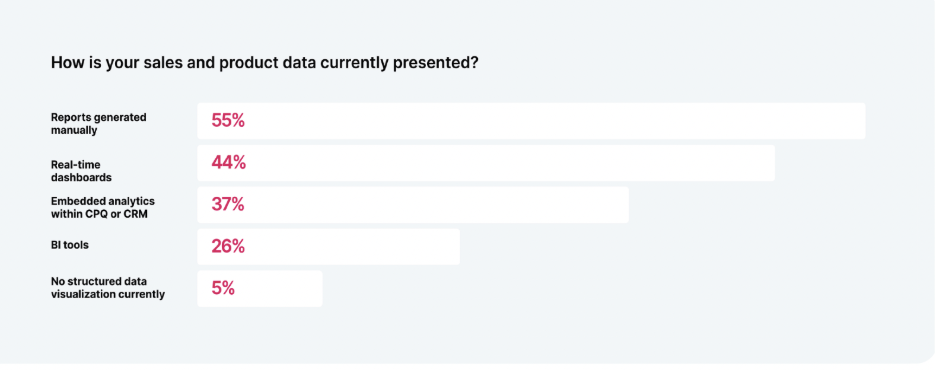
Sales, engineering, and production teams understand the pain of making IT requests to retrieve specific data points, or waiting over a week to get the right report and share it with the right teams. In fact, 55 percent of sales and product reports are still generated manually, according to the Tacton 2025 State of Manufacturing report 

How is your sales and product data currently presented

Fortunately, this tide is changing as more manufacturers invest in dashboard tools, integrate systems with BI tools, or use embedded analytics within their CRM or ERP. The Manufacturing Leadership Council (MLC), in conjunction with Tacton, found that surveyed manufacturers may be more digitized in their reporting than previously thought.  

In the MLC and Tacton webinar, “State of Manufacturing: How Leaders Are Creating a Customer-Centric Smart Factory in 2025,” 31 percent of surveyed manufacturers were using limited dashboards, and 53% were using embedded analytics within systems like CRM or ERP. Yet only three percent had any advanced analytics capabilities.  

Though the shift from manual reporting to dashboards and embedded insights is promising, manufacturers are still only getting a handle on reporting. Where they fall behind is analyzing.  

What is the gap in data analysis?  

Reporting is easy with the right technology, but analysis is a strategic undertaking.  

Though teams may use their CRM’s analytics to see what it says about opportunities, for example, these metrics are not tied to the rest of their sales data. Analysis is completely siloed rather than cross-functional across sales, engineering, or supply chain. And it’s not systematic. 

This makes it nearly impossible to understand the “why” behind outcomes. Imagine in your CRM seeing that you have a 50% win rate for the same truck, at the same price point, across 10 customers. But why? Separate data on configuration will show that different customers have very different use cases—driven in snow versus desert conditions, for example. Getting data in a systematic way is the starting point to interpreting that data.   

The next layer of data maturity: reactive to proactive  

When you understand the “why” behind an outcome, you can proactively prevent or recreate that outcome. Now, you can use opportunity information to configure vehicle solutions that are optimized for customers in that snowy condition at the right price point. Or, you can tweak a product that’s not performing.  

Reports are just a reactive snapshot. A descriptive analysis. Predictive and prescriptive analysis tells you what will happen and what to do about it, based on trends that are visible and the connections made across functions. Centralized data that makes it easy for each function to work from a single source of truth allows these predictive and prescriptive insights to surface.  

Levers for achieving proactive and predictive analytics in industrial manufacturing  

Two strategies, which are not exclusive to each other, can make data maturity acceleration easier than ever.  

First, codifying end-to-end lifecycle data into a single platform or source of truth is essential. Sales data and configurations, engineering and product data, and fulfillment information embedded in a single platform, such as CPQ or a manufacturing lifecycle platform, makes cross-functional analysis possible.  

It also sets the stage for AI, the second lever. AI can turn fragmented, unstructured (and structured) data, such as emails or BOMs or quotes, into structured and actionable insight. When different types of AI are combined, it can also validate this data to ensure accuracy and trust. Using AI, you can accelerate data maturity and scattered data to create structured data with guardrails. 

Integrated data combined with generative AI capabilities takes manufacturers to that next layer. Then, when you make that data easy to access, share, and build in an embedded, intuitive system, decision making is sophisticated and proactive.  

How Tacton brings it all together 

Tacton helps manufacturers move from disjointed reporting to actionable insights by unlocking CPQ data in a single, intuitive platform. 

With Tacton, you gain visibility into how products are configured, priced, and sold, helping you identify performance drivers, growth avenues, and bottlenecks. 

In addition, AI capabilities ensure your teams are ready to move faster with your data. 

Schedule a Demo  

Watch the Full MLC + Tacton Webinar

Back to Resources

5 Pump and Fluid Handling Trends Driving Performance and Profitability

Pump and fluid handling manufacturers are rethinking efficiency through data connectivity, sustainability, and customer experience to drive smarter growth in the digital era.

5 Pump and Fluid Handling Trends Driving Performance and Profitability

Pump and fluid handling manufacturers are accelerating competitiveness through digital transformation. Advanced technologies, e-commerce-inspired buying experiences, and growing demand for energy efficiency are helping brands differentiate themselves, but ongoing trends reveal a common thread: connectivity. Pump manufacturers are linking data with predictability, sustainability with performance, and customers with real-time insight. These forces are catalyzing innovation and transforming go-to-market efficiency across the industry, and the way manufacturers will win is by bringing that same, efficient connectivity to their manufacturing lifecycle.

1. Adoption of digital twins in the pump & fluid handling market

The adoption of digital twins is changing how pumps and fluid systems are designed, sold, and serviced. A twin is a virtual replica of a pump or system that goes beyond CAD by integrating performance curves, materials, operating conditions, and live sensor feedback to mirror real-world behavior.

Adoption is accelerating as manufacturers link IoT data and physics-based simulation to improve reliability and predict maintenance. A recent collaboration between SPX FLOW and Siemens resulted in a digital twin of a mixing tank that uses CFD simulations, real-time industrial data, and flexible control modules. The collaboration demonstrates how virtual testing and optimization de-risk operations and speed improvement cycles for fluid processes that include pumps and valves.  

For commercial teams, digital twins are becoming powerful selling tools. When integrated into configuration and quoting workflows, they allow every quote to double as a performance simulation that validates duty points and helps sales teams demonstrate measurable value. This capability also powers new business models ,such as performance guarantees and pay-per-use contracts, which are increasingly common in utilities and process industries. 

A generational shift is amplifying this trend. The next wave of engineers and buyers—most of them digital natives—expect interactive product selection, 3D visualization, and instant feedback before engaging sales. Manufacturers that embed digital twin logic into their configuration tools and digital experiences stand out as more transparent and aligned with how modern buyers evaluate solutions.

2. Efficiency and sustainability as business drivers

As energy costs rise and environmental regulations tighten, pump and valve manufacturers are prioritizing efficiency as both an engineering and business imperative. According to the Hydraulic Institute, pump systems may account for up to 40% of industrial energy usage. Even a one- or two-percent gain in design efficiency can deliver enormous environmental and economic impact at scale.  

Advances in fluid dynamics and additive manufacturing, for example, are enabling progress by reducing leakage or power demand while extending product lifespan. Buyers now expect verified sustainability documentation as part of every specification, and metrics like carbon data or lifecycle energy are no longer nice-to-haves in the quoting process.

3. Reliability, uptime, and the total cost of ownership mindset

Reliability has become a currency of trust, and it’s the highest pain point for buyers of industrial products, according to Accenture. Buyers are looking beyond purchase price to the true economics of uptime and lifecycle performance. Smart pumps equipped with self-diagnostics, remote monitoring, and predictive analytics are minimizing unplanned downtime and optimizing service schedules. 

Manufacturers offering connected service models, where digital records and real-time insights support every installed asset, are using this to change their business model from product-focused to solution and outcome-focused. This evolution has made total cost of ownership (TCO) the metric that matters most in procurement, guiding decisions toward transparency and long-term value. 

In effect, the most competitive suppliers are providing continuous assurance that every pump in operation performs as expected, with data and service woven into the customer experience. Services and predictive maintenance are also becoming part of the buying process, as manufacturers shift to outcome-based solutions, rather than products alone. But they’re also ensuring that customers get more transparency and reliability in lead times and delivery, as well, which requires a connected experience from sales to production.  

4. Digital and e-commerce-driven procurement

Manufacturers and distributors are seeing double-digit growth in online sales channels as buyers increasingly adopt self-service quoting tools and digital comparison platforms. According to a recent study, e-commerce now represents approximately 13.4 % of total revenue in industrial distribution.  

Platforms designed for spare parts and mid-tier assemblies are increasingly integrating with enterprise procurement systems, making ordering faster and more transparent. At the same time, digital commerce is reshaping how buyers expect to engage with manufacturers. For example, Xylem, a global pump and water technology company, now offers an online catalog and purchasing portal where customers can easily browse, configure, and order pumps or consumables directly. This growing trends reflects how industrial buyers are seeking the same immediacy and convenience they experience in consumer e-commerce.

5. The move toward modular systems

A growing trend in the fluid handling industry is the shift toward modular, configure-to-order systems. Manufacturers are increasingly offering modular pumps, configurable manifolds, and quick-connect assemblies that allow plants to reconfigure or scale operations with minimal disruption. 

This modular approach supports agility in sectors such as pharmaceuticals, food processing, and semiconductors—industries where uptime and flexibility directly influence profitability. It shortens engineering cycles, simplifies maintenance, and reduces total lifecycle cost while improving responsiveness to fluctuating demand. 

When combined with digital twins and connected service data, modular systems can be used to deliver more adaptive industrial performance. 

Maximize efficiency to stay ahead of the market: who is Tacton?  

The pump and fluid handling industry is evolving toward connected, data-driven, and sustainable operations—and Tacton is helping manufacturers lead that change. Purpose-built for complex manufacturing, Tacton’s CPQ and lifecycle management solutions connect sales configuration, engineering, and fulfillment data to create a single source of truth. 

Leading pump OEMs and distributors trust Tacton to streamline every step of the customer journey. Discover how Tacton helps pump manufacturers turn complex products into connected customer experiences.  

Schedule a Demo  

Back to Resources

Generative AI vs. Symbolic AI in Manufacturing: Using Both to Build Trust

Trust in AI depends on explainability, especially when your operations are built on precision. Pairing symbolic and generative AI can help manufacturers build reliable solutions.

Generative AI vs. Symbolic AI in Manufacturing: Using Both to Build Trust

Nearly half of manufacturers are still exploring AI uses cases, with a minority successfully integrating AI into daily operations, according to a Tacton survey of global brands. Ask any manufacturing leader how their organization is integrating AI into their business, and you’ll hear similar sentiments about trust in AI.  

“It makes manual tasks so much faster, but we’re still trying to understand how to harness it correctly.”  

“The majority of our organization is curious about AI, but some are still hesitant. They don’t think that it should replace knowledgeable employees.”  

“AI is still a black box. We want to make sure we invest in a tool that’s reliable and doesn’t hallucinate results when our customers expect accuracy.”  

These are valid concerns in an industry where compliance, complexity, and accuracy factor into every decision. And, these reflections highlight a trend of manufacturers intrigued by AI’s potential but cautious about its reliability, according to a recent Tacton and Manufacturing Leadership Council (MLC) masterclass, “The State of Manufacturing: How Leaders Are Creating a Customer-Centric Smart Factory in 2025”. 

Building trust in AI as a workplace partner, especially in the order-to-delivery process, requires pairing human understanding and education with deterministic intelligence. 

You don’t lack data, you lack structured data 

There’s a common misconception that to successfully use AI, you must have better data—and more of it. “We’ll do AI later, after our data is perfect.”  

While clean data is vital (garbage in equals garbage out), Nils Olsson, Chief Strategy Officer at Tacton, challenged the thinking that data must be perfect.  

“The typical manufacturing company doesn’t lack data. It lacks structure,” stated Olsson. 

Data often lives in scattered silos, such as emails, spreadsheets, or the heads of veteran engineers and sales representatives. It may be inconsistent and lack guardrails for AI tools, like generative AI. But “deterministic” AI can bring structure and guardrails to that data when generative AI and symbolic AI work together.  

Generative AI vs. symbolic AI: demystifying the black box through multiple AI types 

How does this combination work?  

Generative AI in manufacturing learns patterns from large datasets. It synthesizes your unstructured data from emails, CAD notes, service logs, and more, and uses those patterns to surface insights, like optimal configurations based on a customer RFP, for example.  

However, generative AI alone can be prone to hallucinations, and without understanding the logic or reasoning behind it, AI can cause skepticism about its unpredictability.  

Symbolic AI, however, encodes expert knowledge, product logic, and engineering constraints into structured rules. As a type of AI used in technology for decades before AI’s recent propulsion, it helps validate and constrain what generative AI produces.  

As a result—and with the final validation of human expertise—manufacturers get explainable, trustworthy AI outputs and deterministic reasoning that comes from real-life engineering logic. This application is ideal for configuration, pricing, and quoting complex products quickly and accurately.  

Both types of AI alone have limits, but together, they help solve the trust problem and build confidence in AI-assisted user workflows. 

Accelerating AI maturity in manufacturing: strategies for leadership 

Despite its promise, manufacturers need not build proprietary large language models early.   

“Some companies are saying, ‘AI is so important, we’re going to build our own large language model.’ That’s extremely expensive. Why not start with the tools that are already available?” said Olsson.  

Start with small, practical, and safe applications first. Try applications that already exist. Even if your data is still messy, deterministic or rule-based AI systems can make it usable faster by enforcing logic, traceability, and consistency. That combination of symbolic and generative AI helps manufacturers move forward before achieving full data maturity, and every output can be verified against engineering, pricing, or product logic. 

Addressing internal skepticism 

Early success, however, depends as much on people as on technology. At JLS Automation, CEO Craig Souser described how his team addressed internal skepticism through education: 

“We have people that are interested but don’t really know where to start. And then we have the dissenters, who don’t believe AI technology is ever going to replace a good programmer.” 

To build confidence, JLS began with introductory sessions to get people comfortable with the base technology, starting small and demonstrating productivity gains in repetitive workflows.  

Building incremental success 

At Protolabs, Luca Mazzei shares a pragmatic approach to building AI maturity in manufacturing operations through incremental, explainable applications. 

“Even though we’re almost digital by design, we’re going through our own digital transformation. We’re expanding our purview from prototyping to short-run production,” Mazzei said. 

His team uses machine learning for pricing accuracy and efficiency while maintaining human oversight. Generative AI is used in customer service to help agents retrieve relevant, verified information from company systems. And, Protolabs is exploring how AI can read engineering drawings and digitize legacy parts data. 

These applications demonstrate that trustworthy AI starts small, with transparent logic and visible value. 

Build trust in manufacturing AI with Tacton  

Manufacturers that combine symbolic and generative AI are already shortening their path to AI maturity. 

Tacton embodies this hybrid approach within our configure, price, quote (CPQ) software and end-to-end lifecycle platform by offering deterministic, constraint-based configuration and pricing capabilities that seamlessly integrate symbolic AI with emerging generative AI technology. 

For manufacturers ready to move from experimentation to execution, Tacton provides the foundation for trustworthy and scalable AI transformation. 

Learn More About Tacton’s AI Solutions
Watch the Full Tacton and MLC Webinar 

Back to Resources

The CFO’s Guide to Protecting Profit Margins in Manufacturing

Manufacturers can lose as much as 80% of their margin between the quote and delivery. Here’s how CFOs can close that gap and turn visibility into lasting margin control.

Share:

The CFO’s Guide to Protecting Profit Margins in Manufacturing

As a CFO in manufacturing, you know the pressure when profits that look solid on paper shrink by the time the product ships. Some manufacturers lose 75–80% of their profit between order and delivery, not because of market swings, but because of breakdowns in execution. Sales, engineering, and fulfillment still operate on separate systems and truths, leaving gaps that digital transformation has yet to close.  

Some manufacturers focus on production maturity, including strengthening systems and manufacturing efficiency, while others chase growth through new digital customer experiences. Finance leaders are often forced to prioritize one function at the expense of the other. To truly protect manufacturing profit margins, however, CFOs must connect the entire manufacturing lifecycle through one digital thread. 

How CFOs must rethink digital transformation  

CFOs are no longer just financial stewards. They’re becoming the architects of connected enterprises. As manufacturers evolve, finance leaders are uniquely positioned to align commercial ambition with operational execution. Ultimately, if you want to grow a company and deliver profits, you need to ensure that what you sell will match up with what you deliver. 

As Nils Olsson, Chief Strategy Officer at Tacton, explained during a recent Manufacturing Leadership Council panel: 

“It’s not just about some lofty gains in terms of sales… it’s about how you make sure that you don’t lose half of the margins that you signed on for by the end of delivery of the product.” 

Great opportunity lies downstream. Digital transformation should not be a collection of isolated projects but a margin-protection strategy that connects quoting, engineering, and fulfillment in one flow of operational truth, which we like to refer to as the buyer-centric smart factory. When those functions share a single version of truth, what’s sold can be built profitably and delivered predictably. 

Start by asking: 

  • Where do digital investments today stop short of connecting sales and operations? 
  • Can finance see the profitability of every order as it moves through production? 
  • Do teams have shared definitions of cost, margin, and delivery feasibility? 

Where margin loss happens most 

“Eighty percent of the cost in any manufacturing company is typically coming from your production apparatus,” states Olsson.  

Margin erosion often begins after the signature. A deal closed at a 25% projected margin can drop to 15% after design changes or delays and sink further to 3% once warranty claims, penalties, and overhead are factored in. 

To stop this erosion, CFOs need visibility across the entire value chain. Systems should trace every quote to its actual fulfillment cost and highlight margin variance in real time. This visibility allows leaders to ask: 

  • Are quoted margins holding through production? 
  • Which configurations or product lines consistently drive rework or delay costs? 
  • Where are delivery issues or change orders triggering penalties? 

The deeper finance can get into the “why” behind these questions, the better positioned you’ll be to forecast accurately and prevent future losses. 

Engineering: the missing link in digital transformation programs 

“The secret sauce is engineering. How do you digitize and codify that knowledge?” says Olsson.  

By capturing and codifying engineering logic (i.e., the rules, constraints, and validations that define what can be built and at what cost), companies guarantee that every quote reflects operational reality. This alignment prevents costly rework and allows your finance team to forecast more accurately, since feasibility and cost structures are built into every deal from the start. 

Partner with engineering and IT leaders to identify how product rules, constraints, and cost structures can be digitized within configuration and quoting tools. Then, engineering knowledge becomes a shared, reliable foundation for decision making and collaboration between sales, product, and fulfillment. Support pricing and configuration tools that automatically validate lead times, material costs, and manufacturability so margin assumptions hold through delivery.  

Putting transformation into practice: additional steps for protecting manufacturing profit margins 

Protecting margins in manufacturing today requires both system integration and strategic focus. CFOs can take several practical steps: 

  • Build a single source of profitability truth. Integrate data from quoting, fulfillment, and financial systems so teams work from the same cost, price, and delivery assumptions.
  • Operationalize margin governance. Treat margin protection as a managed process. Create shared KPIs that tie directly to margin performance, such as quote-to-delivery variance, rework rate, etc. 
  • Use analytics to shift from reporting to prevention. Move from static quarterly reports to real-time analytics that surface cost variance, lead-time risk, and pricing pressure before they hit the P&L. Embedding analytics into the system will allow for more accurate forecasting and planning.  
  • Start focused, then scale. Begin with one high-leak area (i.e., a product line or region with recurring margin loss). Map out how quoting accuracy, production changes, and delivery costs affect actual profitability. Once improvements are proven, replicate the model across the enterprise. 

As Luca Mozzi, Head of Product and Pricing at Protolabs, noted, many manufacturers are pursuing digital transformation “because of uncertainty, not in spite of it.” Agile, connected systems allow companies to adapt pricing, production, and delivery to protect profit margins even in volatile conditions. 

Tacton’s end-to-end lifecycle platform for manufacturers 

Create your foundation for margin improvement in manufacturing with a system purpose-built for highly configurable solutions.  

Tacton’s platform brings together configure, price, quote (CPQ) capabilities with lifecycle-wide configuration management, order fulfillment, and installed base insight, all powered by real-time analytics. Together, these capabilities create a continuous digital thread that links what’s sold, what’s engineered, what’s delivered, and how it performs in the field. 

Our end-to-end platform includes: 

  • Configure, Price, Quote (CPQ) capabilities ensure every sale is feasible and margin-validated. 
  • Configuration lifecycle management maintains product accuracy and cost alignment as designs evolve. 
  • Connected order fulfillment: Validated configurations flow automatically into production to reduce rework, delays, or penalties. 
  • Lifecycle visibility: Installed-base data and performance insights help manufacturers deliver profitable service, upgrades, and compliance. 
  • Embedded analytics: Finance and operations share one source of truth, so margin protection is proactive. 

With this foundation, manufacturers can truly sell it right, build it right, and deliver it right every time. 

Explore how connected data and lifecycle intelligence can protect your margins and transform profitability. 

Learn More 

Watch the Full Webinar

Back to Resources

Why the Buyer-Centric Smart Factory Is the Future of Complex Manufacturing

Manufacturers face growing pressure to deliver highly configurable solutions on shorter timelines while protecting margins. The buyer-centric smart factory is the answer to delivering on your customer promise, profitably.

Why the Buyer-Centric Smart Factory Is the Future of Complex Manufacturing

Manufacturers of configurable products have the unique challenge of selling complex solutions amid growing demand to compress delivery timelines without losing margin. While the traditional factory is either built around mass standardization and high internal efficiency, or high customization with unpredictable delivery, the buyer-centric smart factory is where manufacturers will be able to achieve both customer satisfaction and efficiency. That means delivering on unique promises to their customers in a smarter, faster way.   

Tomorrow’s manufacturers must go from fragmented, reactive, and unsure, to unified functions, proactive data, and predictable business outcomes. The buyer-centric smart factory starts by meaningfully connecting the end-to-end process through a single source of truth.  

The challenging disconnects in today’s manufacturing model  

Today, manufacturing suffers from a disconnect. Buyer engagement happens in e-commerce sites or in conversations with sales teams who may be unclear if a solution is truly configurable. Engineering and product teams are checking for errors and handholding for quote accuracy. Order fulfillment is adjusting and re-forecasting supply chain needs.  

At each step, and with each competing priority, comes risk to profitability.  

This disconnect also shows up in what buyers experience: before purchase, they expect convenience and transparency, but once the order is placed, they demand reliability, quality, and predictable lead times. Manufacturers struggling with silos can rarely deliver both, and they often sacrifice margin or trust in the process. 

What is the buyer-centric smart factory? 

In the buyer-centric smart factory, the entire value chain works from the same source of truth.  

In an ideal setup, engineering centralizes rules for valid configurations, ensuring consistent product logic across PLM, ERP, and CPQ. Updates flow automatically to sales, preventing errors and protecting margins, while fulfillment receives automated BOMs, flexible scheduling, and order change management. The result is a seamless value chain where profitability is safeguarded end to end, reducing rework and avoiding costly delays that impact margin.

Defining ‘buyer-centric’ and ‘smart factory’ 

When broken down, what makes up the buyer-centric smart factory?

Buyer-centric engagement is where manufacturers are currently differentiating for today’s digital-first customers through:  

  • outcome-based configuration 
  • full solutions (i.e., both products and services) 
  • optimized pricing 
  • visualized buying 
  • automated compliance 

These experiences both fuel and are fueled by shared smart factory data, which includes data from digital twins, PLM, quote and order fulfillment, and supply forecasting.  

However, the buyer-centric smart factory adds two layers that make the connection truly work: 

  • AI to codify knowledge: Capturing engineering expertise and rules so sales can configure an optimized solution accurately and independently, while ensuring compliance and feasibility in real time. 

With a single source of truth, buyer demands flow directly into design, pricing (both products and services), and production. Customization is validated in real time—compliance checks, margin optimization—before an order hits the shop floor. And at every step, data and AI intelligence helps optimize the process.  

One source of truth leads to stronger business outcomes 

When organized effectively, a buyer-centric smart factory creates a seamless connection across the value chain. Sales can confidently deliver validated quotes and orders to fulfillment, while engineering can introduce and launch new products without delays to sales and order fulfillment. The result for the buyer is faster access to innovative products, with greater reliability and confidence in every purchase.

The benefits extend across the entire organization:

  • It’s easier for sales to sell complex products by codifying engineering knowledge and using that to guide selling.  
  • Codified product knowledge and AI make it easier to create the best possible solution for customers to increase win rates.  
  • Engineering has more time to innovate due to detailed and technically validated quotes.  
  • Order fulfillment has more reliability in forecasting and supply chain management and is able to deliver production excellence.  
  • Analytics and planning tools help manufacturers adapt to shifting demand without sacrificing margins. 

The key to achieving a buyer-centric smart factory 

For many manufacturers, achieving this level of efficiency requires breaking deep-rooted barriers between sales, engineering, and fulfillment through adjustments in people, process, and technology. 

Map workflows

It starts with mapping workflows and data to gather the necessary information from each of your systems. With the help of generative and symbolic AI, manufacturers can then determine what can and cannot be delivered based on that data. 

Create a seamless flow between Bill of Materials (BOMs)

In a buyer-centric smart factory, one of the most important workflows to automate is the transition from engineering design to manufacturing execution, specifically from the engineering bill of materials (eBOM) to the manufacturing bill of materials (mBOM). When the full 150% eBOM (representing all possible product variants) is digitized, each customer configuration can automatically generate a precise 100% eBOM that reflects the product exactly as sold. From there, a seamless connection between the quote and order fulfillment processes transforms that configuration into a production-ready mBOM, complete with the correct parts, routings, and work instructions for each factory’s supply chain and production setup. Achieving this level of automation requires a single source of truth that connects sales, engineering, and manufacturing.

Prepare cross-functional teams

But technology alone won’t solve the ‘people’ issue: resistance to change. Teams often cling to familiar processes, but cultural change is just as important as system change. Leadership and teams must reframe priorities so that sales, engineering, and fulfillment are not competing, but rather working toward the same customer outcomes.  

While it’s tempting to tackle challenges separately—pricing today, fulfillment tomorrow—priorities should be addressed together. When data, AI, and analytics are integrated on one platform, manufacturers can connect the front end with reliable fulfillment on the back end. Then, efficiency, profitability, and customer satisfaction stop being trade-offs and start reinforcing each other. 

Vision to reality with Tacton 

Moving from vision to reality requires the right platform to connect these moving parts in a data-driven way. 

Recognized as a leader in CPQ, Tacton is much more than CPQ. We provide an end-to-end manufacturing lifecycle platform that connects buyer engagement with the smart factory through a single source of truth.

CPQ remains a critical link, ensuring every configuration, price, and quote is validated and optimized. Through seamless integration with ERP, PLM, CLM, and other core systems, manufacturers can unify the value chain, streamline order fulfillment, and gain the data needed to innovate with confidence.

Schedule a Demo