Login to Customer Portal
 Contact
 Search
What Is Configuration-Level Analytics? What It Can Tell Each Team in Your Business
See how configuration data reveals the why behind business outcomes across sales, product, finance, and operations.


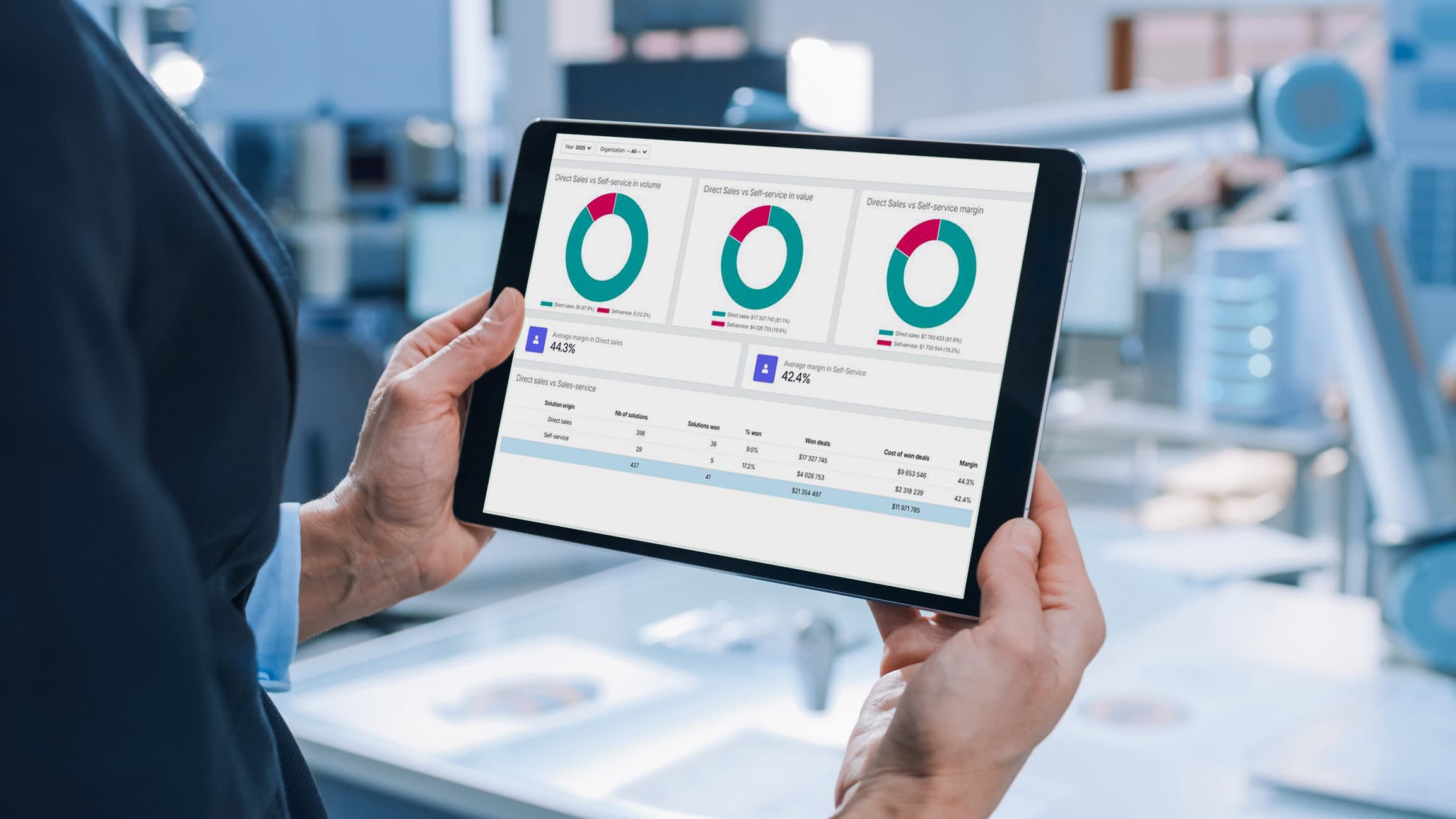
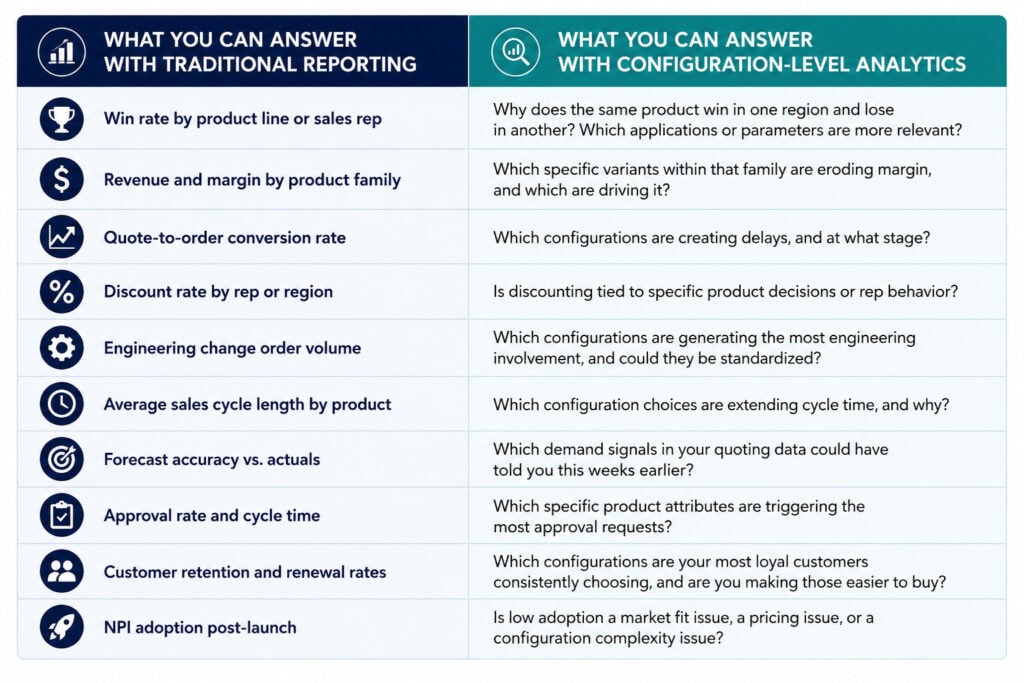
Manufacturers are good at reporting on what happened. You may already run detailed commercial analytics: win rates by product line, discount rates by rep and region, quote-to-order conversion, sales cycle length by product category, engineering change order volume, number of approvals, NPI adoption after launch.
These are the reports that mature commercial and finance teams rely on, and they’re genuinely useful. However, they all share similar blind spots. They tell you what happened, but not the context and decisions behind why. If you have a longer sales cycle with complex quoting processes, the why almost always starts with a decision made during configuration and quoting.
What is configuration awareness?
Configuration awareness is the ability to capture and retain the full context of every configuration decision made during the quoting process, rather than just the final order.
That includes:
- Which options a customer selected, adjusted, or removed
- Which configurations required engineering approval or override
- Which combinations were explored but ultimately abandoned
- How a solution evolved across multiple quote iterations
When selling highly configurable products (e.g., high-mix industrial machinery, engineer-to-order systems, configure-to-order equipment with complex dependencies), this context is generated every time a quote is built. Most businesses generate it. Very few can see it.
What is configuration intelligence?
Configuration intelligence is what happens when that configuration data is connected to business outcomes (e.g., win rates, margin, product performance, demand patterns) and made available for analysis.
Where configuration awareness is about capturing context, configuration intelligence is about using it to answer the questions that drive commercial performance:
- Why do certain configurations win in some markets but not others?
- Which product variants are generating margin, and which are eroding it?
- What demand is building before orders arrive?
- Where is complexity slowing down your sales cycle?
The difference between the questions you can answer now and the questions you can answer with configuration data give you a deeper understanding of how to change business outcomes for the future.
How do you get configuration-level data?
Configuration intelligence requires a CPQ platform that is purpose-built to model complex, configurable products. Manufacturers can use data contextualized by CPQ, such as configuration parameters and pricing logic, to capture not just what was quoted, but the full decision context behind it.
Generic CPQ platforms built for transaction management flatten or lose that context before it can be analyzed. Manufacturers with high product complexity, deep configuration logic, and engineer-to-order or configure-to-order sales motions need a CPQ foundation that holds that context natively, with an embedded analytics layer built on top of it.
How each team in the manufacturing lifecycle can use configuration data
The questions configuration intelligence can answer look different depending on who’s asking. Here’s what it unlocks across the manufacturing business.
Sales and commercial teams: understand what actually wins
Your goal as a sales leader is to achieve consistent commercial performance and win rates across regions, rep teams, and market segments.
Your teams know that winning often comes down to which configuration was recommended and how it fit the prospect’s business goals, not just how well a rep managed the relationship. Configuration data makes the patterns behind those wins explicit and replicable.
By cross-referencing product attributes with industry, application, and geography, teams can see that a specific motor configuration, for example, consistently wins in industrial applications but underperforms in commercial ones — or that a feature set that converts in North America struggles in Europe.
That analysis translates directly into commercial performance:
- Which configurations drive the strongest win rates by market or segment
- Where long sales cycles or high discount rates are tied to specific product decisions
- Which premium configurations convert quickly versus which ones stall
- How product mix connects to revenue outcomes across the team
Product and engineering: build an efficient portfolio that performs
Your goal is to develop a product portfolio that is profitable, manageable, and aligned to what customers actually want.
In high-mix manufacturing, individual variants within a product family can quietly drag on margin, create engineering overhead, or contribute to lost deals, while the family looks successful in aggregate. Configuration data provides the granular visibility needed to refine your portfolio based on customer buying behavior.
Imagine that a product family generating strong revenue overall may contain specific options that are rarely selected, consistently appear in lost deals, or trigger repeated engineering involvement. Configuration data surfaces those patterns and shows where recurring custom requests point toward gaps in the standard portfolio.
Configuration data also enables direct measurement of CTO and standardization progress, something order data and approval counts can’t do alone. If customers repeatedly request the same customization, that’s a signal to create a standard module.
If certain configurations consistently trigger approvals or extend sales cycles, they’re candidates for redesign or retirement.
Across both decisions, configuration data makes it possible to:
- Identify which variants create value and which add complexity without return
- Surface recurring custom requests that signal roadmap gaps
- Measure where CTO and standardization efforts are succeeding and where they aren’t
- Make portfolio investment decisions based on actual customer behavior, not aggregate sales data
C-suite and finance executives: connect configuration decisions to margin
Profitable growth is created by understanding not just where revenue is coming from, but where margin is being made or eroded.
Two deals can look identical on the revenue line while having very different profitability profiles. One closed cleanly. The other looped through approvals, pulled in engineering, and was discounted twice. That difference started during quoting — and standard financial reporting can’t see it.
Imagine that configuration data from your company’s CPQ activity. It shows which specific product attributes and variants are associated with high discount rates, engineering involvement, or extended approval cycles, therefore connecting those behaviors directly to margin outcomes before they accumulate on the P&L.
For commercial, operational, and finance teams, that means:
- Identifying which configurations drive profitable growth vs. erode margin
- Understanding the relationship between product decisions, discount behavior, and deal profitability
- Informing pricing strategy with configuration-level performance data
- Catching margin erosion at the configuration level, not the P&L level
Operations and supply chain: plan around what customers actually build
Production and inventory planning should anticipate early demand and emerging buyer behavior rather than simple order history.
For operations teams in complex manufacturing, order data is a lagging indicator. Configuration data, or how configuration decisions across the sales cycle, moves the signal earlier and at a more useful level of detail.
Take, for example, which motors, controls, accessories, and service options customers consistently select alongside a given machine. Which combinations are gaining frequency in quotes months before they show up in orders. Where component-level demand is quietly building.
That earlier visibility changes what’s possible in planning:
- Anticipate component-level demand based on configuration patterns, not just order history
- Plan inventory around complete solution configurations, not individual SKUs
- Reduce the gap between demand signal and production response
- Build forecasting models that reflect how customers actually configure
Improve commercial performance with your configuration data
Each function is asking different questions, but they share the same underlying problem. The most valuable signals about customer intent, product performance, and commercial outcomes are generated during the configuration and quoting process, and most manufacturing businesses have never had a structured way to see them.
Configuration intelligence allows your teams across the business to connect the context that already exists inside your quoting process to the business outcomes each team is responsible for. When that connection is made, the questions that used to take weeks to answer, or simply went unanswered, become part of how every team operates.
Portfolio Performance Intelligence is built natively into Tacton CPQ, giving product, sales, commercial, and operations teams direct access to configuration-level insights without additional tools, data exports, or IT requests.