 Login to Customer Portal
 Contact
 Search
Why the Configurable Product Is Your Most Important Shared Asset
Treating the configurable product logic as a shared business asset helps manufacturers protect margins at every stage.


Customer demand for personalization is the new norm, and the path to growth and scalability increasingly depends on offering configurable products (configure-to-order with engineer-to-order exceptions) without errors. However, that configuration complexity leaves room for quote and order inconsistencies that flow downstream and slow operations, increase costs, and put pressure on margins.
While ERP and PLM systems are valuable for managing orders and inventory or product versions, respectively, these systems alone were never designed with the configurable product as their primary focus.
When configuration logic is not the focus, it’s harder to scale and sell products that are different every time.
The configurable product as the center of manufacturing
You have systems of record for customers, products, and operations, but you may not have a singular governed source for how your configurable products actually work.
The limitations of existing systems
The configurable product is the common thread connecting every department. In many organizations, the knowledge that defines how products can be configured lives across engineering documents, spreadsheets, ERP records, tribal knowledge, and individual experts. Manufacturers have traditionally organized their systems around functions. ERP manages operations. PLM manages product data. CRM manages customers and their requirements.
A company may have world-class ERP and PLM systems but still struggle to answer a simple customer question: “Can we build this?” because the configuration knowledge isn’t centralized.
In practice, this means creating a single place for governing the configuration logic, rules, and dependencies that determine how products can be configured, sold, and manufactured.
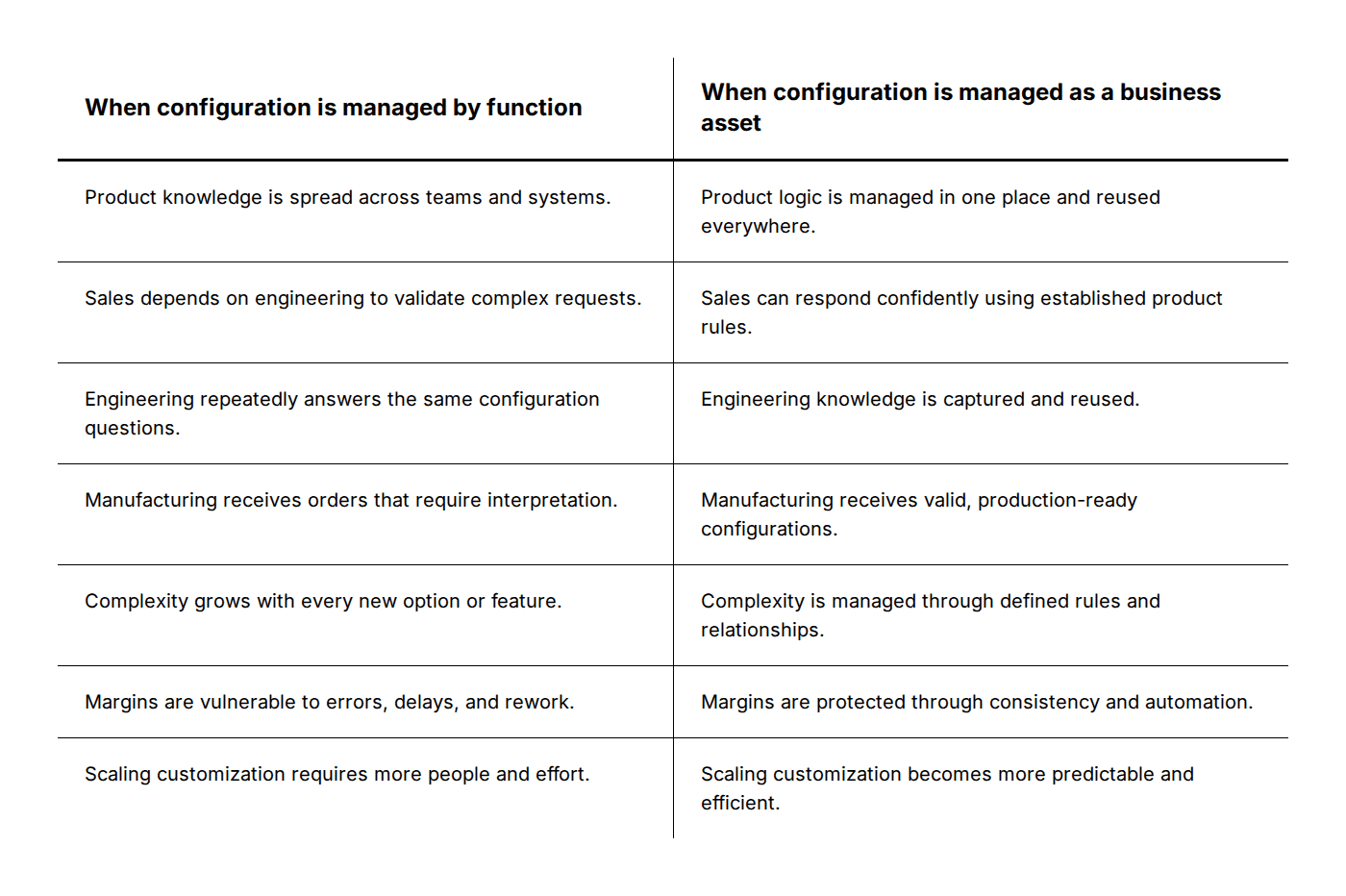
Putting the configurable product at the center means treating that product logic as a shared business asset. Instead of each department maintaining its own copy of configuration knowledge, the same rules and relationships are defined once and shared across sales, engineering, manufacturing, and operations.

The cost of de-centering configuration
Manufacturers are looking for ways to standardize what can be standardized while still meeting unique customer requirements. Without a structured way to manage configuration logic with the potential for hundreds or thousands of configured combinations, complexity grows beyond the capabilities that the business and its systems can manage. For example, an ERP may give the order as a line item but not have the capability to show the full configuration.
The need for a shared understanding of configurable products is becoming more urgent. In Tacton’s State of Manufacturing 2026 research, manufacturers identified managing increasing product complexity as one of the most significant challenges impacting both operational efficiency, growth, and margin. At the same time, organizations reported ongoing difficulties coordinating information across sales, engineering, and manufacturing teams, highlighting how product knowledge often remains fragmented across the business.
What is the competitive advantage?
Consider a manufacturer that receives a request for a highly customized product. On paper, the opportunity is attractive. The customer is willing to pay a premium, and the order could be highly profitable. Without engineering’s configuration knowledge and constraints encoded upfront, sales can’t answer that question alone, and the order stalls waiting on a per-deal engineering review.
When the logic behind configurable products is highly complex and fragmented, answering those questions can take days or weeks. Meanwhile, competitors with a centralized understanding of their product configuration logic respond quickly. They know what is possible, what is manufacturable, and what can be delivered profitably.
Today, 62% of manufacturers said they experience moderate to severe margin erosion starting at the quote cycle through order fulfillment, highlighting the financial impact on those who are unable to respond efficiently and effectively.
The role of ERP and PLM in a configuration-centric enterprise
The argument for a system that centralizes configuration is not an argument against existing systems.
ERP and PLM remain essential. PLM excels at product data management, documentation, workflows, and governance. ERP excels at operational execution, financial processes, procurement, inventory, and manufacturing operations. Both are foundational systems.
However, most ERP and PLM systems were originally designed around fixed products and fixed structures.
As organizations begin managing thousands, or millions, of potential product combinations, the configuration logic itself becomes a separate challenge that neither system was specifically designed to solve.
A configuration-centric layer adds the configuration logic that governs how configurable products can be assembled, sold, and manufactured while complementing existing ERP and PLM systems. Together, these systems create a complete digital foundation.
How to make the configurable product your central focus
Manufacturers organize their systems around function, not around the product itself: ERP owns operations, PLM owns product data, CRM owns the customer relationship. Centering the configurable product means inverting that logic, building around the one asset every function actually depends on, rather than letting each function define its own version of it.
Many manufacturers already have CRM, ERP, and PLM systems in place. The next step is not replacing them, but connecting them through a shared understanding of the configurable product.
The ideal starting point is in defining configuration possibilities.
In practice, that looks like three shifts:
A single definition of “buildable.” Instead of sales, engineering, and manufacturing each maintaining their own version of product configuration knowledge, that knowledge should be managed in one place and shared across every function. Every other system references it rather than recreating it.
Changes that propagate instead of requiring re-entry. When a configuration rule changes, whether from a new option, a supplier substitution, or an engineering fix, that change should reach every dependent system on its own. If a single change still requires someone to manually update it in three or four places, there isn’t actually a single source of truth yet, just multiple copies of an old one.
Customer requirements should remain connected to the configurable product throughout the lifecycle, not stop at the sales order. When the manufacturing BOM is generated automatically from the configured product definition rather than rebuilt by hand, every part and step on the shop floor stays traceable back to the customer requirements that drove it while remaining aligned with approved configuration changes. The same configuration knowledge that defines what is manufacturable can also be used to validate what is sellable. Sales, engineering, and manufacturing all work from the same configuration knowledge rather than maintaining separate copies.
Bring configuration into focus
When manufacturers centralize configuration knowledge, the entire manufacturing lifecycle feels the impact.
Sales can generate quotes faster with confidence that configurations are buildable. Engineering is less burdened by repetitive work and has better control over product complexity and configuration management across systems. Manufacturing gets cleaner handoffs, with orders that reflect valid configurations and Bills of Material that reflect proper manufacturability.
But most importantly, companies see improved margins due to those cleaner handoffs. Successful companies can confidently tell customers “yes”, because they understand their products deeply enough to know what is possible, what is manufacturable, and what remains profitable.
Learn more about building an effective smart factory.
About the Author

Hanna Kemppainen is SVP Executive Projects at Tacton. She previously led Variantum as CEO, a Finnish software company whose configuration management solutions helped manufacturers manage product configuration truth from engineering through delivery. That work now sits at the center of Tacton’s Buyer-Centric Smart Factory, connecting what’s sold to what’s engineered and built. At Tacton, Hanna leads integration efforts to bring teams, systems, and customers onto one connected platform.


