Login to Customer Portal
 Contact
 Search
Why Your AI Sales Agent Isn’t Helping You Win Deals with Industrial Buyers
Buyers are open to digital and AI-assisted sales, but adoption depends on whether the tools provide accurate, contextual, and verifiable answers.



AI sales agents and self-service sales experiences are increasingly popular, and 23% of industrial buyers who do not have a digital self-service tool available from their supplier wish they did. However, research from the 2026 Industrial Buyer Expectations Report, which surveyed global buyers across industry sectors, found that buyers don’t want AI sales agents because they automate the process. They want added value and more complete information. They want faster access to trustworthy answers, whether those answers come through a digital tool, an AI assistant, or a knowledgeable sales representative.
These findings suggest that channel preference is only part of the issue. Buyers want to make progress without waiting, while retaining access to expertise when the decision becomes technical, high-risk, or unusual. The most valuable digital experience combines independent discovery, accurate configuration guidance, current commercial and fulfillment information, and a seamless transition to a person when judgment is required.
Buyers want digital-first sales tools that answer consequential questions
Many digital sales experiences focus on speed: making it easier to search a catalog, complete a form, or request a quote. Buyers value that convenience, but the research shows greater demand for information that reduces their risk. Many respondents report frustrations with incomplete information or sales conversations that don’t start with their needs. Buyers also cite that a lack of product information often leads to escalation for simple configuration questions.
Where AI agents would provide the most value is in predictive and real-time intelligence that help reduce risk in the investment, according to surveyed global buyers:

These capabilities help buyers answer four essential questions:
- Is this the right product for our application?
- Is this configuration valid and complete?
- What will it really cost?
- Can the supplier deliver it when we need it?
A digital experience that only accelerates the front-end interaction leaves the most valuable questions unanswered.
Why digital-first sales tools don’t replace value from internal sales
A buyer may research independently, start a configuration online, ask an AI assistant to interpret a requirement, and then involve a salesperson or engineer. The experience should preserve context across all of those interactions.
That means carrying forward the buyer’s stated requirements, selected options, supporting documents, unresolved questions, and previous recommendations. A buyer should not have to begin again after requesting human help, and a salesperson should not provide an answer that contradicts the digital channel.
Self-service works best for repeatable tasks: exploring product families, narrowing options, checking compatibility, accessing documents, and developing an initial configuration. Human assistance becomes more valuable when requirements are ambiguous, trade-offs need explanation, commercial negotiation begins, or the buyer requests something outside the standard model.
The goal is a connected journey that gives the buyer the right level of assistance at each decision.
AI can help interpret intent and surface knowledge
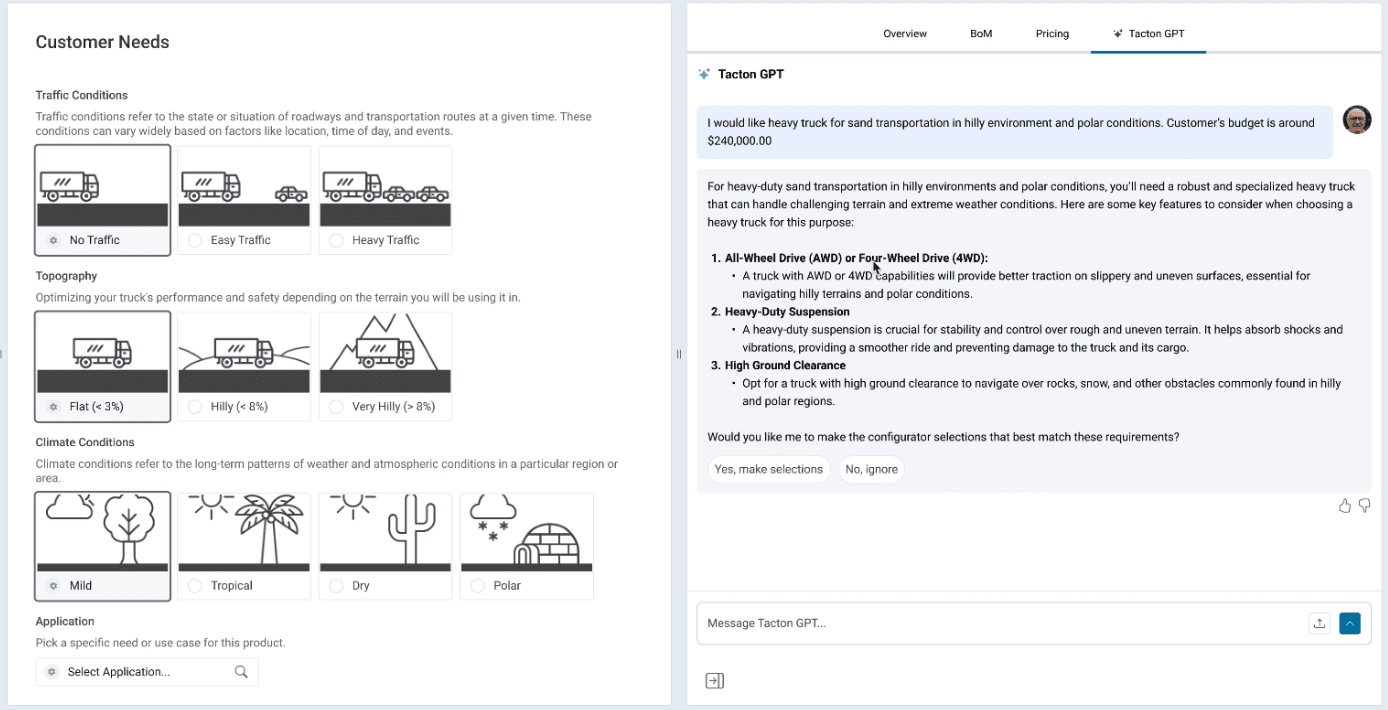
AI adds value when it reduces the effort required to express a need or find relevant information. In complex manufacturing sales, that can include:
- Extracting requirements from an RFQ, specification, or email
- Asking follow-up questions when critical information is missing
- Translating natural-language needs into configuration inputs
- Finding approved product and technical content
- Explaining why an option was recommended or rejected
- Comparing valid alternatives and their trade-offs
- Helping a salesperson prepare a more complete response
- Measuring configuration confidence and flagging potential misconfigurations
These uses address a real information problem. Thirty-nine percent of buyers currently need a sales representative to answer basic configuration questions, and buyers frequently encounter inconsistent information across channels. AI can provide a more accessible interface to product knowledge, especially outside normal business hours or early in the research process.
Its answer is only valuable when the underlying knowledge is current and reliable.
How manufacturers can increase accuracy in digital-first tools and AI sales agents
Twenty-seven percent of surveyed buyers have found a supplier’s AI tool inaccurate or unhelpful. A generic or incorrect answer can be worse than a delayed answer, because it gives the buyer false confidence or forces them to verify everything with a person.
In complex products, generative fluency is different from technical validity. An AI system may be able to explain a product convincingly without knowing whether the combination is manufacturable, compliant, appropriately priced, or available.
Manufacturers should therefore ground AI assistance in governed sources and require deterministic validation for critical decisions, where generative AI is validated by constraint-based rules. AI can interpret the buyer’s language and propose a path. Configuration rules should verify compatibility, performance, and required dependencies. Pricing logic should calculate the commercial result. Connected fulfillment data should support statements about availability and lead time. Experts should review genuine exceptions.
This division of responsibility allows AI to improve access and usability without becoming an uncontrolled source of product truth.
The digital thread determines how useful AI-automated processes can become
The Tacton 2026 State of Manufacturing Report found that 79% of manufacturers are investing in or exploring AI. Yet only 33% report consistent configuration logic across sales, engineering, and production.
Buyers want AI to provide real pricing, real availability, realistic lead times, and reliable recommendations. Those answers draw on information owned by different functions and systems. If each source describes the product differently or updates on a different schedule, AI may make fragmented information easier to access without making it more accurate.
A stronger foundation connects customer requirements, configuration rules, pricing, engineering definitions, parts availability, production capacity, and fulfillment outcomes. AI can then help the buyer or salesperson interact with that digital thread through natural language, recommendations, summaries, and proactive guidance.
Design AI and digital selling around trust
Manufacturers can use five principles to guide the experience:
- Let buyers make meaningful progress independently, including saving and sharing their work.
- Preserve requirements and configuration context when the buyer moves between digital and human channels.
- Make the source and assumptions behind important recommendations understandable.
- Validate technical, pricing, and delivery claims against governed systems before presenting them as commitments.
- Escalate ambiguity and exceptions to the right salesperson, product expert, or engineer.
Success should be measured through more than interaction volume or response time. Manufacturers should monitor whether buyers complete configurations, accept recommendations, request fewer clarifications, receive fewer quote revisions, and experience greater consistency between quoted and delivered outcomes.
The buyer research points toward a hybrid future. Digital tools and AI can make complex product knowledge more accessible and help buyers move faster. Salespeople and engineers continue to provide context, judgment, and accountability. A connected data foundation makes both channels more reliable. The manufacturer that combines those elements can offer buyers what they are actually requesting: a clearer path to the right product and greater confidence that the promise will hold.
To get more insights from buyers about the challenges and opportunities they face, read our 2026 Industrial Buyer Expectations report, which surveyed buying committees across North America and European industry sectors.