Login to Customer Portal
 Contact
 Search
What is the 150% BOM in configure-to-order manufacturing?
A 150% BOM captures the full range of product possibilities. Learn how engineering and manufacturing structures combine with configuration logic to create an order-specific product.



A configurable product can’t be represented by one fixed list of parts. It may support thousands or millions of valid combinations across models, applications, regions, performance requirements, and factories. Every customer order uses only a small portion of those possibilities. Each department, from sales to production, have their own Bill of Materials (BOM) with that information translated in a language most relevant to their functions.
A 150% Bill of Materials provides a structured way to represent that variability. It contains the complete range of approved components, options, and variants for a product family. When used in conjunction with configuration logic, manufacturers can determine which possibilities belong in a specific customer solution based on their application requirements.
The concept becomes more useful when it extends across engineering and manufacturing. Across the lifecycle, the 150% eBOM defines engineering possibilities, configuration logic determines which combinations are valid, and the 150% mBOM defines how those possibilities can be built at a specific factory. Connecting these layers preserves customer intent and shows what was selected, why it is valid, and how it should be built.
What is a 150% BOM?
A 150% BOM is a comprehensive product structure containing all approved components, modules, options, and variants that may be used across a configurable product family. It represents the full range of what could be designed or built, including alternatives that would never appear together in one finished product.
Consider a configurable industrial pump system. Its 150% product structure may include:
- Multiple pump sizes and impeller designs
- Different motor power, voltage, and efficiency options
- Seal materials for different fluids and operating conditions
- Stainless steel, cast iron, and specialty-alloy housings
- Regional electrical and regulatory packages
- Optional monitoring, control, and safety components
- Compatible frames, piping, connectors, and mounting assemblies
No customer receives all of these components. The 150% BOM defines the approved universe from which configuration rules derive a valid product.
Manufacturers may also call it a super BOM, configurable BOM, variant BOM, or maximum BOM, although the exact meaning can vary by organization and system.
How do 150% eBOMs, configuration logic, and 150% mBOMs work together?
The 150% concept can apply to both engineering and manufacturing, but the structures serve different purposes. Configuration logic connects them by determining which possibilities are valid for a particular requirement, order, and factory.
The 150% eBOM defines engineering possibility
The 150% engineering BOM contains the complete range of approved engineering components and variants for a product family. It captures design intent, including the parts, assemblies, technical relationships, and revisions that engineering has approved.
For the pump example, the 150% eBOM may include every compatible motor, seal, housing, control system, and certification package. PLM or PDM typically remains the system of record for this product data.
Configuration logic resolves valid combinations
The configuration model contains the rules, constraints, and relationships that determine which choices can appear together. It connects customer requirements with engineering features and components.
This configuration layer is not necessarily another BOM. It provides the logic required to navigate the 150% structure. It can determine which motor meets a requested performance level, which seal works with a specific fluid, and which regional package satisfies the applicable regulations.
The same governed logic can support sales configuration, engineering validation, and order fulfillment. This keeps each function aligned around a common definition of what is valid without requiring every team to use the same BOM structure. This configuration logic is often defined in Configure, Price, Quote (CPQ) tools.
The 150% mBOM defines manufacturing possibility
The 150% manufacturing BOM contains the approved manufacturing content that may be required across product variants, factories, and production scenarios. It can include manufacturing parts, subassemblies, local alternatives, routing options, operations, and documentation.
Engineering and manufacturing structures do not always organize the product in the same way. The 150% eBOM may group components according to product function and design intent. The 150% mBOM may reorganize those components around how they will be sourced, assembled, tested, packaged, and built.
Mappings between the eBOM and mBOM preserve the relationship between engineering intent and manufacturing execution. Fulfillment rules then derive the specific mBOM, routing, and instructions needed for an individual order and factory.
What is the difference between a 150% BOM and a 100% BOM?
A 150% BOM contains the complete range of approved possibilities for a configurable product family. A 100% BOM contains the specific content required for one valid configuration or order.
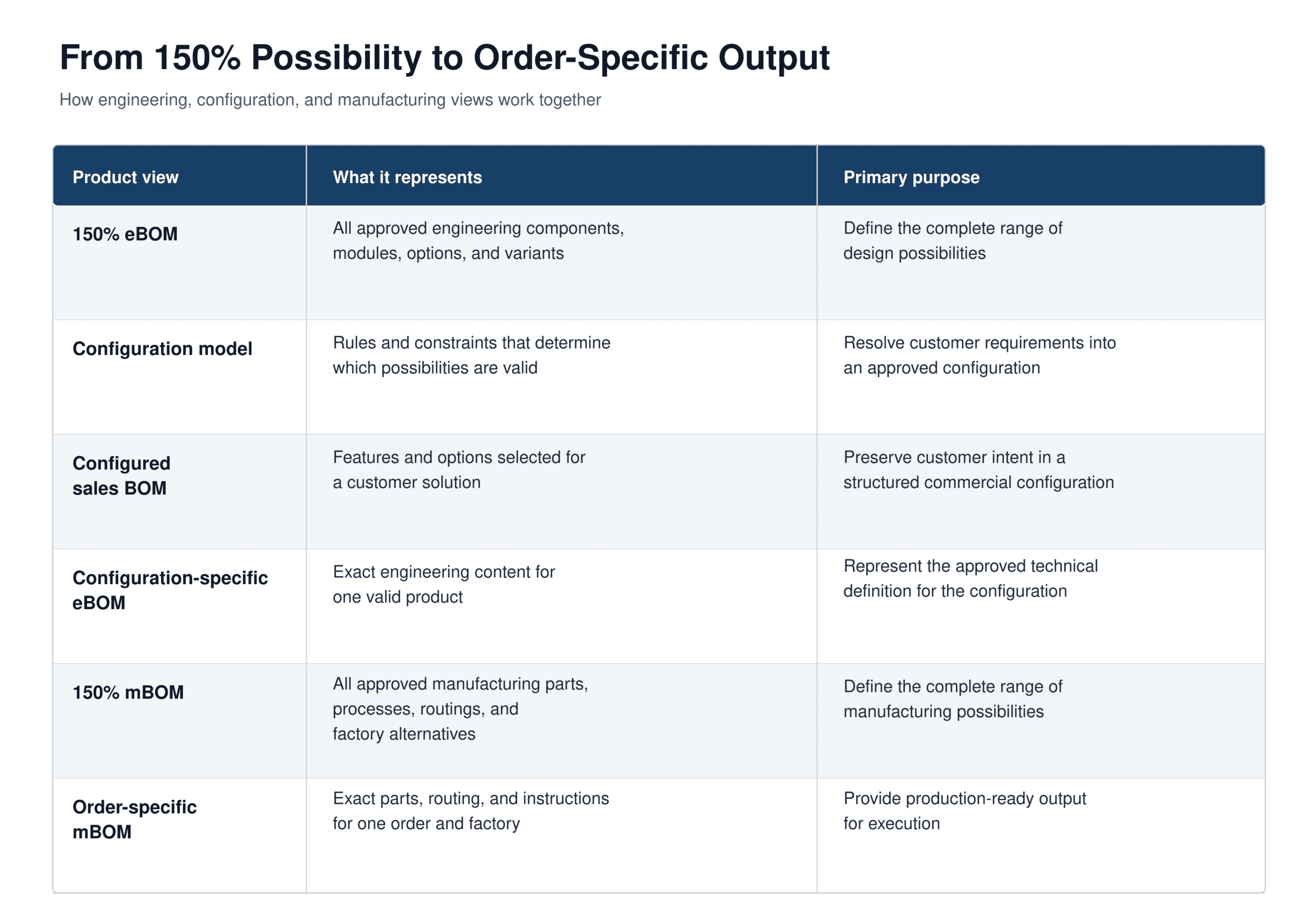
A customer requirement moves through these connected views. A request for a pump that handles a corrosive fluid at a defined flow rate, operates on a specific voltage, and meets an explosion-protection standard resolves to one compatible engineering definition. Manufacturing logic then applies the selected factory, approved local parts, routing, and production instructions.
The order-specific outputs represent the 100% needed to fulfill that requirement. They remain traceable to the broader 150% structures and the configuration decisions that produced them.
Why does a 150% BOM need configuration rules?
The 150% BOM provides the available content. Configuration rules make that content usable.
Without governed rules, a 150% BOM is a large product structure containing many possible parts. It cannot reliably determine which combinations satisfy the customer’s performance requirements, engineering constraints, regulatory obligations, and manufacturing conditions.
Configuration logic can define:
- Which options are required, optional, or mutually exclusive
- Which components and assemblies are compatible
- How customer requirements translate into technical selections
- Which rules vary by region, application, or regulatory standard
- Which factory or site can fulfill the configured product
- When an engineering or manufacturing exception requires approval
- Which engineering and manufacturing content results from each decision
Constraint-based configuration is especially valuable for highly configurable products because it models relationships rather than attempting to predefine every possible configuration path. Teams can introduce a new option, component, or constraint without rebuilding every combination separately.
The structure, rules, and mappings work together as a governed product model. That model defines the boundaries of what can be sold, engineered, and built.
Why is the 150% BOM important to the manufacturing digital thread?
The 150% BOM gives the manufacturing digital thread a structured definition of product variability. Configuration logic connects that definition with customer requirements, while downstream mappings preserve the relationship through engineering and production. When configuration logic is layered on the BOM and product logic, it is a foundation for being able to automate BOM management and create production BOMs from quotes or sales orders.
It connects customer intent to engineering decisions
Customers usually describe what the equipment must do, where it will operate, and which performance, safety, or regulatory conditions it must meet. They rarely describe the part-number hierarchy required to deliver it.
Configuration rules translate those requirements into valid selections from the 150% eBOM. This creates a traceable relationship between the customer’s need and the engineering content included in the product.
Passing only a final SKU or document downstream loses much of that context. A connected product model preserves both the selected content and the decisions that produced it.
It creates a governed definition of product variability
Sales, engineering, and manufacturing often maintain different versions of the same configuration knowledge. Commercial rules may live in CPQ, engineering constraints in PLM or spreadsheets, and production logic in ERP, MES, or local factory systems.
Only 7% of manufacturers define configuration rules once and reuse them across systems, according to Tacton’s 2026 State of Manufacturing report. The remaining organizations must maintain or reconcile configuration knowledge across multiple functions.
A governed configuration model gives those systems a common definition of valid product variability across the different BOM structures. Each platform can retain ownership of the information and processes it manages while using consistent rules and relationships.
It makes product changes traceable
An engineering or manufacturing change rarely affects every configuration in the same way. A revised motor may apply only to certain voltages, regions, frame sizes, factories, or regulatory packages.
Connecting the change to the relevant conditions makes it possible to identify affected options, configurations, quotes, orders, and manufacturing outputs. Teams can then determine when the revision becomes effective and whether an active customer order requires review.
Only 21% of manufacturers automatically propagate engineering changes to downstream systems. For the rest, every product update creates another manual synchronization requirement across product models, sales tools, BOMs, and factory systems.
It supports factory-specific manufacturing output
The configured engineering definition still needs to be translated into the way a particular factory will build the product. That translation may account for site capabilities, local sourcing, approved alternates, routing, work instructions, testing, and documentation.
Only 23% of manufacturers automatically generate BOMs from quotes. Manual handoffs leave production teams to interpret what was sold and reconstruct how it should be built. Errors at this stage can lead to order corrections, rework, expedites, margin erosion, and missed delivery commitments.
A connected 150% mBOM and fulfillment model allow manufacturers to derive precise factory output without losing the link to the customer configuration or engineering definition.
Where should the 150% BOM and configuration logic be managed?
The 150% product definition should work across the manufacturer’s existing system landscape, with clear ownership for each type of data and governed relationships between systems.
- PLM or PDM owns engineering product data. It remains the system of record for the 150% eBOM, parts, product structures, CAD data, revisions, and engineering change processes.
- Configuration management governs configurability. It manages the rules, dependencies, constraints, releases, and applicability that determine how the 150% engineering structure becomes a valid customer-specific product.
- CPQ applies released configuration and commercial logic. It connects customer requirements with valid features, options, pricing, and a structured sales configuration during the buying process.
- A fulfillment or manufacturing configuration layer manages manufacturing variability. It can maintain the 150% mBOM, map engineering content to manufacturing structures, and derive order-specific output for the selected factory.
- ERP and MES manage planning and execution. They receive the order-specific mBOM, routing, documentation, and related data required to plan materials, schedule production, and execute the order.
- Service or asset systems preserve the delivered configuration. They maintain the context required for parts, maintenance, upgrades, and lifecycle support.
This model creates connected sources of truth. Product data does not need to be manually recreated in every application, and configuration logic does not need to diverge across sales, engineering, and manufacturing.
How does a 150% BOM help manufacturers scale customization?
A governed 150% product model allows manufacturers to reuse engineering and manufacturing knowledge across more products, orders, regions, and factories.
Engineering defines approved product possibilities. Configuration rules turn customer requirements into valid product selections. Manufacturing defines how those possibilities can be produced across different sites. Each order receives a precise output derived from the same governed foundation.
This supports configure-to-order at greater scale while preserving a clear path for genuine engineer-to-order exceptions. Repeatable configurations can move through the lifecycle with less manual intervention, while engineering focuses on requirements that fall outside the approved product model.
The business impact can include:
- Greater sales confidence that configured products are technically valid
- Less engineering effort spent reviewing repeatable combinations
- Clearer control over new options, revisions, and lifecycle status
- More complete and factory-specific production information
- Fewer manual translations between sales, engineering, and manufacturing
- Better visibility into the impact of customer and internal order changes
- Fewer order corrections, expedites, and production delays
- Stronger traceability from customer requirements to delivered equipment
For manufacturers trying to increase customization without adding engineering effort and downstream risk at the same rate, the 150% BOM provides an important foundation.
What does connected 150% BOM management require?
Connected 150% BOM management depends on a shared product vocabulary, explicit system ownership, governed configuration logic, cross-functional mappings, and lifecycle controls.
Manufacturers should be able to answer several questions:
- Which product options and variants belong in the 150% eBOM?
- Which manufacturing parts, processes, and factory alternatives belong in the 150% mBOM?
- Which system owns each part, structure, rule, price, and manufacturing attribute?
- How do customer requirements resolve to engineering features and components?
- How does engineering content map to manufacturing structures and routing?
- Which rules can be defined once and reused across sales, engineering, and fulfillment?
- How do approved revisions and order changes affect active configurations and downstream outputs?
- How is the as-sold and as-built context preserved for service?
A practical starting point is one configurable product family and one complete order flow. Teams can prove how a real customer requirement moves through engineering possibility, configuration logic, and factory-specific output. The standards, mappings, and governance established in that flow can then expand to more products, business units, and factories.
How Tacton supports a connected 150% BOM model
Tacton helps manufacturers connect customer requirements with governed product configurability and manufacturing-ready output while allowing PLM, ERP, MES, and other systems to retain their intended roles.
Frequently asked questions about 150% BOMs
Is a 150% BOM the same as a super BOM?
Often. Manufacturers may use the terms 150% BOM, super BOM, configurable BOM, variant BOM, or maximum BOM for a structure containing all available product possibilities. Exact definitions vary by organization and system.
What is the difference between a 150% eBOM and a 150% mBOM?
A 150% eBOM contains the full range of approved engineering components and variants. A 150% mBOM contains the full range of approved manufacturing parts, processes, routings, and factory alternatives. Configuration and fulfillment rules connect the two structures and derive the content required for a specific order.
Is the configuration model another type of BOM?
No. The configuration model contains the rules, constraints, and relationships used to select valid content from the 150% structures. It provides the logic that connects customer requirements with engineering and manufacturing outputs.
Can a 150% BOM be used directly for manufacturing?
A 150% BOM contains alternatives and mutually exclusive content, so it is not a production order by itself. Configuration and fulfillment logic must resolve it into the order-specific mBOM, routing, and instructions required by the selected factory.
How does a 150% BOM support CPQ?
The 150% eBOM provides the engineering structure behind available product options. CPQ applies released configuration and commercial logic to customer requirements so sales can create a valid solution and structured sales BOM.
Why is a 150% BOM important to the digital thread?
A 150% BOM gives sales, engineering, and manufacturing a connected definition of product variability. Governed configuration logic preserves customer intent, engineering decisions, product changes, and factory-specific manufacturing outputs across the lifecycle.